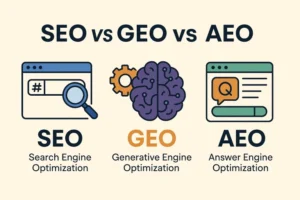

If you run a local business a restaurant, a law firm, a salon, a plumbing company, a boutique retail store your competition for online visibility has fundamentally changed. The question is no longer just ‘am I appearing in Google search results?’ It is ‘am I the business that Google, Google Maps, ChatGPT, and AI assistants recommend when someone nearby is looking for exactly what I offer?’
Local SEO has always been distinct from general SEO. It focuses on geographic relevance, proximity, and local trust signals. But now, local SEO has a new dimension: AI search systems are increasingly the first stop for local recommendations, and the businesses they recommend are the ones that have done the work to be findable, credible, and well-documented across every digital touchpoint. This guide covers what local businesses need to know and do to stay visible in the era of AI-assisted search.
When someone asks Google or ChatGPT ‘best accountant near me’ or ‘where can I get my car serviced in [city]’, the AI does not simply return a list of businesses sorted by review count. It synthesizes information from multiple sources: Google Business Profiles, local citations, website content, review platforms, and increasingly, the conversational data it has ingested during training.
Google’s AI Overviews for local queries often pull directly from Google Business Profiles which means an incomplete or outdated profile can exclude you from consideration before a potential customer ever sees your name. AI chat assistants like ChatGPT and Perplexity draw from the web at large, meaning your website content, your directory listings, and the consistency of your business information across platforms all influence whether you are mentioned or passed over.
The stakes are higher than most local business owners realize. AI does not scroll through page two. It makes a recommendation, and the businesses it recommends tend to get the call.
For local businesses, the Google Business Profile (GBP) is the foundation of AI search visibility. It is the source Google trusts most for verified information about local businesses and it is the primary data source for Google’s AI Overviews in local search contexts.
A complete, well-maintained Google Business Profile does the following:
Optimizing your GBP is not a one-time task. It requires ongoing attention: responding to reviews promptly, publishing regular posts, uploading fresh photos, keeping hours accurate during holidays and events, and adding your services in detail. The businesses that treat their GBP as a living marketing tool consistently outperform those that set it up once and forget it.

NAP stands for Name, Address, and Phone Number the three core data points that identify your business across the internet. NAP consistency means that these three pieces of information are identical across every platform where your business appears: your website, your Google Business Profile, Yelp, Facebook, local directory listings, Chamber of Commerce pages, industry association sites, and anywhere else your business is mentioned.
Why does this matter for AI? Because AI systems aggregate information from multiple sources to build a picture of your business. When the information is consistent, it reinforces confidence in your identity and authority. When it is inconsistent when your address is slightly different on three different platforms, or your phone number has changed but not been updated everywhere AI systems treat that inconsistency as a trust signal problem.
Audit your NAP data annually at minimum. Use a tool like Moz Local, BrightLocal, or simply search your business name and check every result manually. Correct any inconsistencies you find, and ensure that new listings created in the future match your canonical NAP exactly.
Online reviews have always mattered for local businesses. In the age of AI search, they matter more than ever for two distinct reasons.
First, the volume and sentiment of your reviews directly influence where AI systems place you in local recommendations. A business with 200 reviews averaging 4.7 stars will consistently outperform a business with 15 reviews averaging 4.2 stars in AI-generated local results, all else being equal.
Second, the content of your reviews provides AI systems with natural language data about your business the services you offer, the quality of your work, how you treat customers, and what makes you distinct from competitors. Detailed, specific reviews that mention your services by name contribute to AI systems’ understanding of what your business does and who it serves.
Building a review acquisition strategy is now a core component of local search optimization:
• Ask every satisfied customer to leave a Google review make it easy by sharing your direct review link.
• Respond to every review, positive or negative, professionally and promptly.
• Never purchase or incentivize fake reviews the consequences for GBP penalties are severe and increasingly detectable.
• Encourage customers to be specific in their reviews mentioning the services they received and what they valued about the experience.

Most local businesses have claimed their Google Business Profile and accumulated some reviews. Far fewer have implemented local schema markup on their websites which represents a significant missed opportunity.
LocalBusiness schema is structured data that you add to your website’s code to give search engines and AI systems a machine-readable summary of your business. It specifies your business name, address, phone number, hours, price range, geographic area served, and the specific services you offer. When AI systems crawl your website, this structured data helps them understand and accurately represent your business.
The implementation is more straightforward than it sounds. A properly formatted JSON-LD block embedded in your website’s header or footer communicates everything AI systems need to confidently recommend your business. For businesses with multiple locations, implementing schema for each location individually is essential.
If your website was built by a professional agency, ask whether LocalBusiness schema has been implemented. If it has not, this is one of the highest-ROI technical fixes available to a local business.

Many local business websites make the mistake of generic content descriptions that could apply to any business anywhere. AI systems, like human customers, are looking for specificity. Your website content should clearly and repeatedly establish where you operate, who you serve, and what makes you the right choice for local customers. This means:
Local SEO in the age of AI is ultimately about being the most credible, best-documented local business in your category. The businesses that win are the ones that have left nothing ambiguous for search engines, for AI systems, or for potential customers.
Studio 8s works with local businesses across industries to build websites, Google Business Profiles, and digital strategies that perform in both traditional and AI-powered local search. If you want your business to be the one AI recommends when local customers are looking, we can help you get there. Contact Studio 8s today for a local SEO assessment.
Digital Growth Assistant · Online