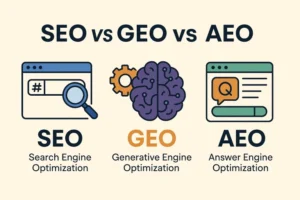
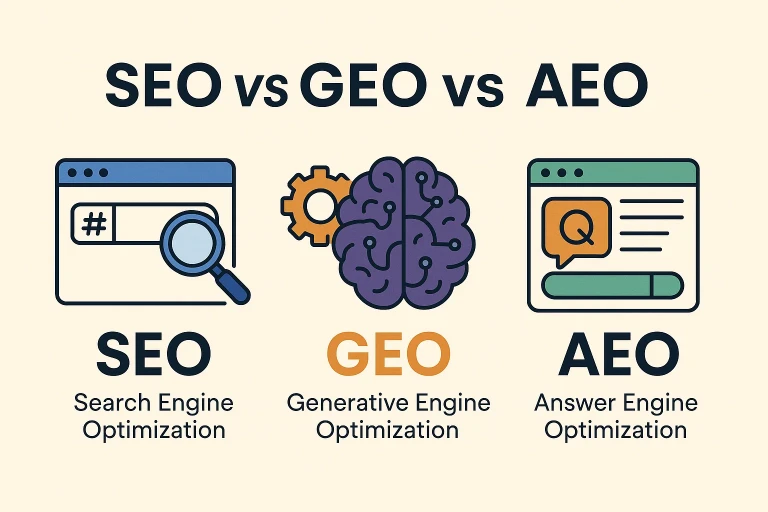
The way people search for businesses, products, and answers has changed more in the last two years than it did in the previous decade. Google still dominates, but it is no longer the only destination that matters. ChatGPT answers questions. Perplexity synthesizes information from across the web. Google’s own AI Overviews now give direct answers before a single organic result appears on screen. For business owners and marketing managers, this creates a challenge: the strategies that worked in 2020 are no longer enough. Three distinct disciplines now determine whether your website gets found Search Engine Optimization (SEO), Answer Engine Optimization (AEO), and Generative Engine Optimization (GEO). Understanding each one, and how they work together, is the difference between a website that generates leads and one that quietly collects dust.
Search Engine Optimization is the practice of improving your website so that it ranks higher in traditional search engine results pages. It encompasses everything from the keywords on your pages to the speed at which those pages load, the number of credible websites linking to yours, and the technical architecture underlying your entire site.
SEO is built on three foundational pillars:
• Technical SEO: Site speed, mobile responsiveness, crawlability, Core Web Vitals, structured data, and clean URL architecture.
• On-Page SEO: Keyword research, content quality, meta titles and descriptions, heading structure, and internal linking.
• Off-Page SEO: Backlinks from authoritative sources, brand mentions, and digital PR signals that communicate trust to search engines.
Google’s algorithm processes hundreds of ranking signals simultaneously, but the underlying question it is always trying to answer is the same: which page on the internet best satisfies this user’s intent? The businesses that answer that question most comprehensively through genuinely useful, well-structured, technically sound content earn the top positions.
SEO is not dead. It remains the highest-ROI digital marketing channel for most businesses. But it is no longer the complete picture.
Answer Engine Optimization is the practice of structuring your content so that search engines and AI assistants can extract and present your answers directly without the user needing to click through to your website.
This might sound counterintuitive. Why would you optimize for an experience where the user never visits your site? Because visibility is influence. When Google’s featured snippet answers a question using your content, your brand name appears at the top of the results page. When a voice assistant reads out your definition, your authority grows. When AI systems reference your explanation, your credibility compounds.
AEO is fundamentally about format.
The same information written as flowing paragraphs versus structured Q&A will perform very differently in answer engine results. To optimize for AEO:
• Use your target question as a verbatim heading (H2 or H3), exactly as a user would type or speak it.
• Provide a clear, direct answer in the first two to three sentences beneath that heading.
• Follow the answer with supporting detail, examples, and context.
• Implement FAQ schema markup so search engines can identify and extract your Q&A pairs automatically.
• Write in clear, declarative language avoiding jargon, hedging, and unnecessary complexity.
Featured snippets, People Also Ask boxes, knowledge panels, and voice search results are all AEO territory. If your competitors are appearing in these placements and you are not, you are losing visibility to people who never even reach the organic results.

Generative Engine Optimization is the newest of the three disciplines, and the one that most businesses have not yet begun to address. GEO is the practice of making your content attractive to large language models the AI systems powering ChatGPT, Perplexity, Google’s AI Overviews, Microsoft Copilot, and others so that they cite your website as a source when generating answers.
When a user asks ChatGPT ‘what is the best web design agency in [city]’ or ‘how do I improve my website’s SEO‘,
ChatGPT does not run a live search in real time. It draws on its training data and, increasingly, on retrieval-augmented generation pulling from live sources that have signaled authority and trustworthiness. GEO determines whether your content is the kind of source these systems trust enough to reference. The signals that matter for GEO are different from traditional SEO, though they overlap:
• Topical authority: AI systems favor sources that cover a subject comprehensively, not just individual pages with isolated keywords.
• Source credibility: Websites with strong backlink profiles, clear authorship, and recognized expertise are cited more frequently.
• Content structure: Well-organized content with clear definitions, statistics, and direct statements is easier for AI to extract and attribute.
• E-E-A-T signals: Experience, Expertise, Authority, and Trust. The quality framework Google codified also governs how AI systems evaluate source reliability.
• Freshness: Regularly updated content signals that your information is current and maintained.
GEO is not about gaming algorithms. It is about being genuinely authoritative on the topics your business covers and making that authority legible to both human readers and machine systems.

The most important thing to understand about these three disciplines is that they are not competitors. They are layers of the same strategy.
Think of it this way. SEO gets your website ranked so that humans and search engine crawlers can find it. AEO structures your content so that search engines can extract and feature your answers prominently. GEO builds the kind of deep, authoritative, well-cited content that AI systems recognize as trustworthy source material.
A business that invests in SEO alone will rank in traditional results but miss the growing share of queries answered by AI. A business that focuses only on AEO will optimize for snippets but lack the topical depth that earns GEO citations. A business that chases GEO without solid SEO foundations will lack the crawlability and backlink profile that makes their content visible in the first place.
The three disciplines reinforce each other. Strong technical SEO makes your content accessible. Clear AEO formatting makes it extractable. Deep topical authority makes it citable. All three, done well, compound into a website that performs across every type of search experience traditional, AI-generated, and everything in between.
For most small businesses, marketing managers, and growing brands, the answer is all three executed in the right sequence, with SEO foundations first.
The businesses that will dominate search in 2026 and beyond are the ones making these investments today not after their competitors have already claimed the territory. The transition from keyword-based search to AI-mediated discovery is not a future possibility. It is happening now, in every industry, in every market.
The good news is that the core of good marketing has not changed. Be genuinely useful. Be clearly organized.
Be credibly authoritative. The platforms that reward those qualities have multiplied which means the opportunity for businesses willing to adapt has multiplied too.
Studio 8s helps small businesses, e-commerce brands, and growing companies build websites and digital strategies that perform across SEO, AEO, and GEO. If your website is not generating the visibility or leads it should, we can show you exactly why and what to do about it. Get in touch with our team at Studio 8s for a free website review.
Digital Growth Assistant · Online